
Artificial Intelligence in Dentistry: Evidence, Education, and Emerging Practice
A Trend We Note
Looking Beyond Isolated Technical Results
Dental AI studies are paying closer attention to how tools perform in restoration design, implant planning, education, reporting, and clinical workflows.
Some systems are showing useful gains in specific settings. Others still need broader testing, outside validation, and clearer evidence of patient benefit.
Industry is also increasing direct exposure through conferences, hands-on workshops, demonstrations, and clinician education. That visibility is helping shape which technologies gain familiarity, credibility, and early adoption.
The most closely watched tools will be those that pair strong presentation with evidence, practical value, and appropriate professional review.
Clinical Applications
Automated Restoration Design May Reduce Design Time
A systematic review evaluated artificial intelligence applications in the design of single tooth-supported restorations.
The included studies examined systems capable of generating restoration proposals with limited manual input. The findings suggest that AI-supported software can reduce the time required to produce an initial design and may generate morphology comparable with conventional computer-aided design in selected circumstances.
The available studies differed in software, restoration types, evaluation methods, and definitions of acceptable performance. Much of the evidence was technical or laboratory-based rather than prospective clinical research.
Clinical Relevance
An initial design may be useful without being ready for fabrication or delivery.
Clinicians and dental laboratory professionals must still evaluate margins, contacts, occlusion, emergence profile, esthetics, cleansability, material requirements, and the condition of the supporting tooth or implant.
Automated design may reduce repetitive work, but current evidence does not support removing professional review from the process.
Source:
https://pubmed.ncbi.nlm.nih.gov/42225535/
AI Is Being Studied Across Implant-Planning Workflows
A systematic review examined artificial intelligence in dental implant treatment planning, with particular attention to CBCT segmentation and identification of relevant anatomical structures.
The included studies evaluated tasks such as detecting teeth and edentulous regions and segmenting structures used during planning. Some reported high accuracy for specific applications.
The studies varied in dataset size, imaging conditions, AI architecture, validation methods, and clinical setting. Strong performance for one segmentation task does not establish that a complete implant plan is accurate or appropriate.
An Important Limitation
An error early in a digital process can affect later stages.
Incorrect identification of a boundary or anatomical structure may influence implant position, angulation, depth, prosthetic planning, or the presumed relationship to adjacent anatomy.
AI-supported segmentation may reduce preparation time, but clinicians must be able to inspect, modify, and approve the result before it becomes part of a surgical plan.
Source:
https://pubmed.ncbi.nlm.nih.gov/42187626/
AI-Guided Photogrammetry Evaluated in Complete-Arch Implant Treatment
A prospective clinical study evaluated an AI-guided navigation photogrammetry system for complete-arch implant impressions and immediate loading.
The system integrated implant-coordinate data with preoperative anatomical and prosthetic information. This differs from research in which AI performs an isolated task without being connected to later stages of treatment.
Complete-arch treatment is a relevant setting for this type of evaluation because accurate transfer of implant positions is necessary for restorative fit and passive connection.
What Clinicians Should Note
The study provides clinical information about an integrated workflow, but it does not establish that the approach will perform similarly across all operators, systems, treatment conditions, or patient populations.
Comparative studies, reproducibility data, and longer-term restorative outcomes remain necessary.
The study is best interpreted as an evaluation of an emerging workflow rather than evidence supporting universal adoption.
Source:
https://pubmed.ncbi.nlm.nih.gov/41742006/
AI Models Assessed for Endodontic Working-Length Support
A systematic review evaluated AI models developed to assist with working-length determination and identification of apical landmarks in endodontic procedures.
Working-length determination requires consideration of radiographic information, electronic apex-location findings, root anatomy, image quality, previous treatment, procedural conditions, and other clinical factors.
AI may support the identification of landmarks or provide an additional measurement. Its output remains dependent on the images and data used to develop and evaluate the model.
For Clinical Use
Performance reported on a study dataset may not account for unusual anatomy, image distortion, restorative materials, resorption, prior treatment, or other conditions encountered in practice.
AI-generated measurements should therefore be considered with established clinical methods rather than used independently.
Source:
https://pubmed.ncbi.nlm.nih.gov/41867636/
Education and Professional Preparation
Dental AI Education Is Moving Toward Practical Use
A recent overview examined the use of artificial intelligence in dental teaching, assessment, personalized learning, simulation, educational-content development, and prediction of academic performance.
These applications may help faculty organize material, provide structured practice, or offer learners additional feedback. They also introduce concerns involving accuracy, privacy, academic integrity, dependence on generated information, and faculty preparedness.
The review identified curriculum development and faculty training as important requirements for responsible educational use.
For Educators
General exposure to AI is not sufficient preparation.
Learners need structured opportunities to compare AI-generated information with accepted evidence, identify unsupported statements, examine uncertainty, and understand when an output should not influence a decision.
Faculty must also be prepared to evaluate the tools being introduced into teaching rather than assuming that technical availability establishes educational value.
Source:
https://pubmed.ncbi.nlm.nih.gov/42435734/
Training Improves Generative AI Output, but Does Not Assure Accuracy
A study compared trained and untrained generative AI platforms in the development of case-based multiple-choice questions involving traumatic dental injuries.
The newer or trained platforms produced stronger results than the untrained general-purpose system. The investigators nevertheless found limitations in answer quality and the accuracy of supporting rationales.
The Educational Point
Connecting a generative AI system to defined content, instructions, or training may improve its usefulness. It does not remove the possibility of incomplete, incorrect, or unsupported output.
Questions, explanations, cases, and learning materials produced with generative AI should be reviewed by appropriately qualified faculty before being presented to learners.
Source:
https://pubmed.ncbi.nlm.nih.gov/42410937/
Interest in Dental AI Continues, Alongside Knowledge Gaps
A scoping review examined the knowledge, attitudes, and practices of dentists, dental students, and patients regarding artificial intelligence.
Across the included literature, attitudes toward AI were often favorable. Participants recognized possible applications involving diagnosis, efficiency, treatment planning, and education.
Knowledge levels, training exposure, and practical understanding varied. Concerns included reliability, privacy, reduced human interaction, professional responsibility, and uncertainty about how AI should enter clinical decisions.
For the Profession
Interest in AI does not necessarily indicate readiness to evaluate or use it.
A clinician may expect AI to become more common while still lacking the information needed to assess a product, interpret an output, explain its use to a patient, or respond when the system appears incorrect.
Education should therefore address intended use, limitations, privacy, communication, verification, and professional responsibility together.
Source:
https://pubmed.ncbi.nlm.nih.gov/42387532/
Standards and Connected Systems
Dental Standards Work Expands Into AI and Information Exchange
The American Dental Association marked 100 years of dental standards development in June 2026.
The ADA reported that current projects include artificial intelligence, three-dimensional printing, and standardization of data content for information exchange. These areas extend dental standards work beyond traditional materials, equipment, and instruments.
Implementation Significance
Responsible AI use depends on more than model performance.
Clinicians, purchasers, educators, and healthcare organizations need clear information regarding intended use, data requirements, testing conditions, known limitations, performance measures, system updates, and the responsibilities retained by the user.
Standards can provide a more consistent basis for describing and evaluating these characteristics. They do not replace independent assessment of whether a system is appropriate for a particular setting.
Source:
https://adanews.ada.org/ada-news/2026/june/100-years-of-dental-standards/
ADA Calls for a Dental-Specific Approach to Interoperability
The ADA urged federal regulators to account for dentistry’s distinct clinical workflows and health-information-technology challenges as interoperability and prior-authorization requirements develop.
Dental information may be distributed across imaging systems, electronic dental records, medical records, scheduling platforms, laboratory systems, referral networks, and payer portals. These systems do not always exchange information easily or consistently.
Relevance to Dental AI
Many AI applications rely on access to complete and correctly structured information.
A system may have limited value when the necessary data cannot be retrieved, interpreted, or returned within the clinician’s normal workflow. Manual transfer between systems may also introduce duplication, missing information, or error.
Interoperability is therefore part of the practical evaluation of AI, particularly for applications intended to function across clinical and administrative systems.
AAAI-D in Action
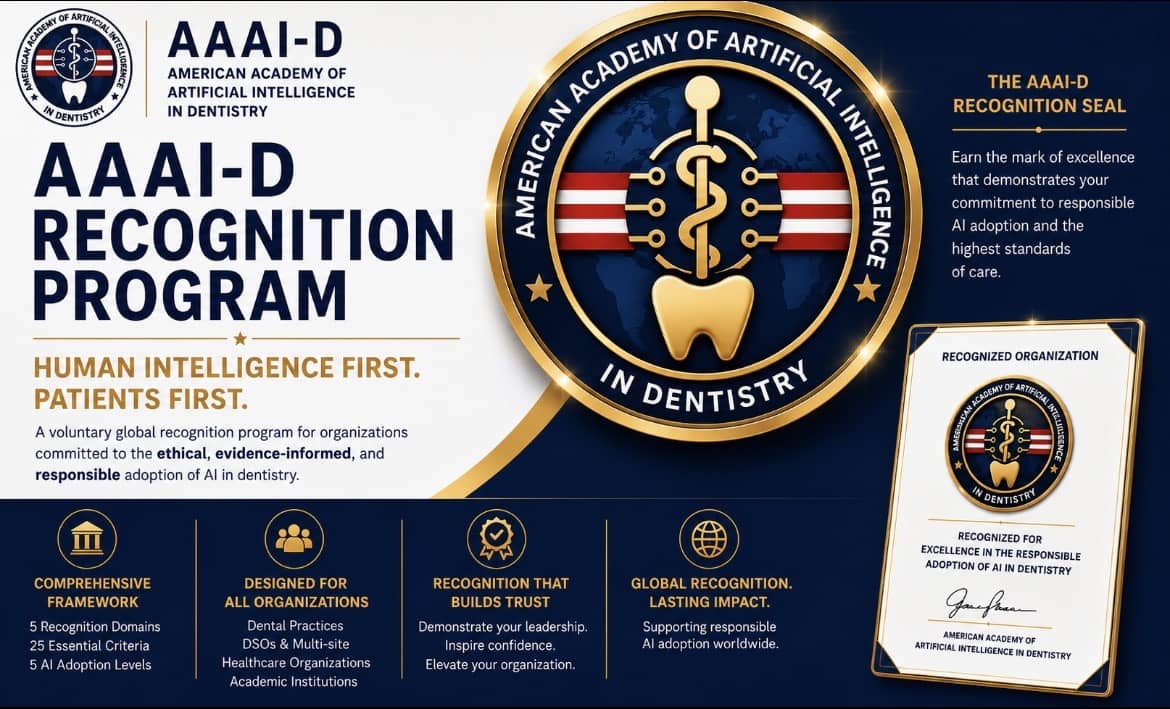
AAAI-D Recognition Standards Program Launches
AAAI-D has introduced its Recognition Standards Program to provide organizations with a structured framework for examining the responsible adoption of artificial intelligence.
The program is intended for:
- Private dental practices
- Dental service organizations
- Dental schools
- Hospitals and healthcare systems
- Federal and public institutions
- Industry organizations
The Recognition Standards include:
- Five Recognition Domains
- 25 Framework Elements
- Five AI Adoption Levels
The framework allows an organization to consider its current approach across areas such as governance, evidence, workforce preparation, implementation, and accountability. It can also help identify practices that are established, areas that remain incomplete, and priorities for further development.
The five adoption levels recognize that organizations begin from different positions and may proceed at different rates. Recognition is therefore based on the organization’s documented practices and level of development rather than the number of AI products it uses.
The program does not require organizations to adopt a particular technology, vendor, or implementation model.
Purpose of the Program
AI adoption can involve questions extending beyond technical performance. Organizations may also need to consider:
- Who is responsible for evaluating and approving a system
- What evidence is reviewed before adoption
- How clinicians and staff are educated
- How patient information is protected
- How system performance and limitations are documented
- How concerns, errors, or unexpected results are addressed
- How continued oversight occurs after implementation
The Recognition Standards provide a common structure for examining those questions.
The Academy’s guiding principle remains:
Human Intelligence First. Patients First.
Pre-applications for the Recognition Standards Program will open in September 2026.
Program information:
AAAI-D Recognition Program
Virtual Simulation Dental AI Lab Review Workgroup Begins
AAAI-D has formed a member review workgroup under the leadership of Dr. Ibrahim Bayrakdar to evaluate the initial content available through the AAAI-D Virtual Simulation Dental AI Lab.
The current version of the Lab is available to eligible AAAI-D members.
The Lab is an educational resource. The modules are designed to strengthen the critical-thinking skills of students and clinicians. It does not replace the instructor-led training essential to developing radiographic interpretation skills.
Its availability through AAAI-D should not be interpreted as endorsement of a commercial product, diagnostic instruction, or a substitute for clinical training.
Simulation Lab:
AAAI-D Virtual Simulation Dental AI Lab
2027 AAAI-D Annual Meeting
From Innovation to Implementation
The inaugural AAAI-D Annual Meeting will be held on:
Friday, July 9, 2027
Los Angeles, California
The meeting is intended for clinicians, educators, researchers, health-system leaders, practice leaders, dental support organization executives, technology professionals, policymakers, students, and other participants in oral healthcare.
Abstract categories include:
Enterprise Dentistry
Organizational adoption, procurement, implementation, workforce preparation, operational experience, risk, and quality across dental groups and healthcare systems.
Clinical Care
Research and experience involving imaging, diagnostic support, treatment planning, patient communication, clinical workflow, and specialty applications.
Connected Dental Ecosystem
Interoperability, information exchange, virtual care, administrative systems, access, and connections among clinical and organizational platforms.
Emerging Technologies and Innovation
Simulation, robotics, generative AI, multimodal systems, research methods, and other developing applications relevant to dentistry and oral health.
Governance, Ethics, and Policy
Professional responsibility, transparency, data use, oversight, organizational governance, standards, and policy.
Abstracts may address original research, clinical applications, implementation initiatives, educational programs, technology evaluations, quality-improvement work, governance initiatives, and health-system experience.
Submissions that report measurable outcomes, operational experience, workflow effects, implementation barriers, or lessons learned are encouraged. Primarily promotional or commercial submissions may not be accepted.
Event details:
2027 AAAI-D Annual Meeting
Leading Educator’s Perspectives

Dr. Nathalia Andrade on AI Literacy, Education, and Responsible Innovation
By Carol Yassa
Interview Correspondent
American Academy of Artificial Intelligence in Dentistry (AAAI-D)
Nathalia Andrade, DDS, MSc, PhD, is a Clinical Assistant Professor in Periodontics and Oral Pathology at the University at Buffalo School of Dental Medicine and an educator actively engaged in advancing the responsible integration of artificial intelligence into dental education and clinical practice.
With a lifelong passion for technology and innovation, Dr. Andrade has spent her career exploring how emerging tools can enhance patient care, education, and research. In a recent conversation with the American Academy of Artificial Intelligence in Dentistry (AAAI-D), she shared her perspective on preparing the next generation of dental professionals for a future in which artificial intelligence will increasingly become part of everyday practice.
A Lifelong Interest in Technology
For Dr. Andrade, the journey into artificial intelligence began long before dental school.
“My father is an engineer, and when I was a child, he taught me how to build computers, troubleshoot software, and explore new technologies,” she recalls. “That early exposure sparked a curiosity that stayed with me throughout my life.”
As she progressed through dentistry and later specialized in periodontics, that curiosity naturally carried into clinical care. She continually sought technologies that could improve treatment outcomes, increase precision, and elevate the standard of patient care.
Over time, her passion for technology evolved into a passion for teaching. She began helping dental students, residents, clinicians, and faculty members understand how emerging technologies could support education, research, and clinical practice.
“When AI emerged as a transformative technology, adopting and teaching it felt like a natural extension of what I had already been doing throughout my career,” she says.
Teaching AI While Preserving Clinical Judgment
Dr. Andrade believes AI has tremendous educational value when used thoughtfully. In particular, she sees benefits in content organization, image analysis, treatment-planning support, and administrative efficiency.
These tools can help learners process information more effectively and spend more time developing higher-level clinical reasoning skills. However, she is equally clear about the areas where AI should not replace independent thinking.
“Students still need to develop diagnostic reasoning, communication skills, and decision-making abilities independently before relying on AI assistance,” she explains.
For that reason, she intentionally incorporates activities that strengthen critical thinking alongside AI-based learning exercises. Her goal is not simply to teach students how to use technology, but to ensure they understand how to evaluate information critically and apply it responsibly.
Moving Beyond the Question of Whether Students Use AI
One of the most significant changes Dr. Andrade has observed is that AI is already deeply integrated into the daily routines of many learners.
Rather than debating whether students should use AI, educators are increasingly focused on helping them use it effectively.
“The conversation has shifted from whether students will use AI to how they should use it safely and appropriately,” she notes.
This shift has reinforced the importance of AI literacy within healthcare education. According to Dr. Andrade, students need formal guidance on validating information, protecting patient privacy, understanding system limitations, and recognizing situations where human expertise must remain central.
“Safe AI use starts with understanding how the technology works and where it can fail.”
Understanding the Limitations
While artificial intelligence continues to advance rapidly, Dr. Andrade cautions that some of its most important limitations become apparent only through routine use.
One challenge she encounters frequently is inconsistency.
“AI systems can produce highly convincing answers that are partially incorrect or unsupported by evidence,” she explains.
She also notes that outputs often vary depending on the quality of the prompt and the context provided. These limitations may not always be highlighted in published studies but can become obvious in day-to-day educational and clinical settings.
For educators and clinicians alike, these realities underscore the importance of verification, critical assessment, and maintaining professional judgment rather than accepting AI-generated outputs at face value.
AI and the Future of Dental Education
Looking ahead, Dr. Andrade expects AI to become increasingly embedded within educational workflows.
Students may routinely work with AI-powered tutors, personalized learning systems, automated feedback platforms, and simulation technologies. Faculty members will likely use AI to assist with the development of educational materials, assessments, and learning resources.
Despite these advances, she remains confident that the educator’s role will remain indispensable.
“Human mentorship, clinical judgment, professionalism, and ethical decision making cannot be replaced by technology.”
Rather than replacing educators, AI will allow them to devote more time to the uniquely human aspects of teaching and mentorship that remain essential to preparing future clinicians.
Ensuring Innovation Benefits Everyone
Dr. Andrade also highlights an important challenge facing healthcare and education: ensuring that the benefits of AI are distributed equitably.
She acknowledges that new technologies are often adopted first by larger institutions and organizations with greater financial resources. Investments in software, infrastructure, training, and implementation can create barriers for smaller practices and underserved communities.
At the same time, she believes AI has the potential to become a powerful force for expanding access to care.
“It could help standardize care, improve efficiency, and extend expertise to underserved areas,” she says.
Realizing that potential, however, will require more than technological innovation alone. It will also require thoughtful implementation, broad accessibility, and education that empowers clinicians to use these tools safely and effectively.
As educators and healthcare leaders continue to shape the future of AI in dentistry, Dr. Andrade believes equal attention must be given to access, training, and responsible adoption.
Looking Forward
As artificial intelligence becomes increasingly integrated into dentistry, Dr. Andrade believes success will depend less on the technology itself and more on how future clinicians are trained to use it.
The next generation of dental professionals will need technical fluency, but they will also need strong critical-thinking skills, ethical awareness, and the ability to evaluate information independently.
By combining innovation with thoughtful education, Dr. Andrade sees an opportunity to prepare clinicians who can leverage the strengths of AI while preserving the human judgment that remains at the heart of patient care.
She suggests that the conversation is no longer about whether AI will be part of dentistry, but about ensuring that we teach people how to “use it safely and appropriately.”
About Dr. Nathalia Andrade
Nathalia Andrade, DDS, MSc, PhD, is a Clinical Assistant Professor in Periodontics and Oral Pathology at the University at Buffalo School of Dental Medicine. Her work focuses on the intersection of technology, education, and clinical practice, with particular interest in helping students, residents, clinicians, and faculty members responsibly integrate emerging technologies into healthcare.
Through her teaching and scholarship, she advocates for the thoughtful adoption of artificial intelligence while preserving the critical role of human judgment, ethics, and mentorship in dental education.
AAAI-D Fellowship
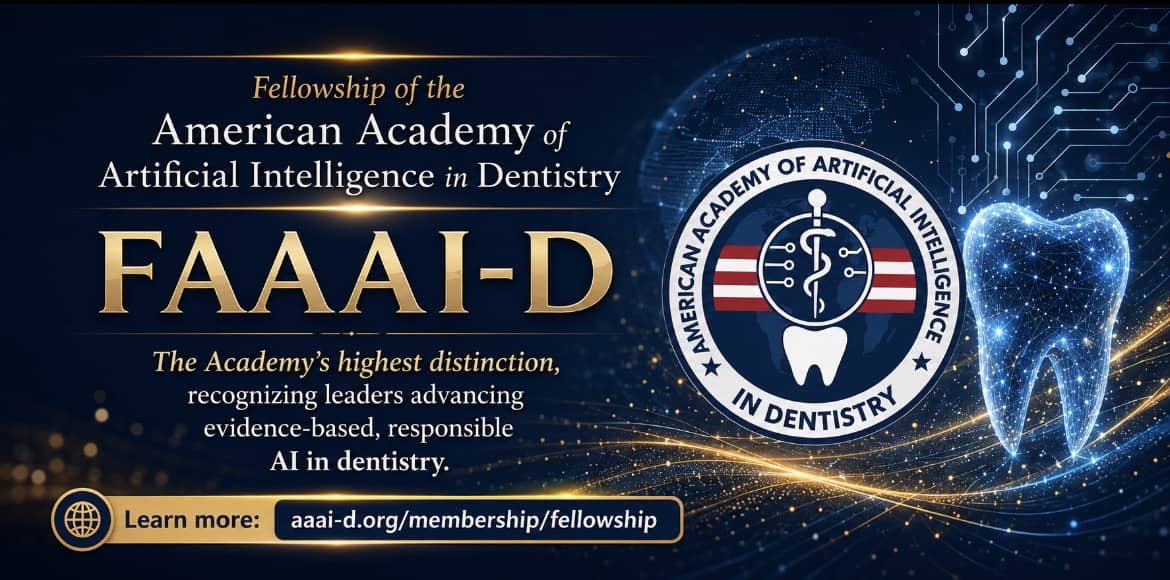
AAAI-D Fellowship recognizes sustained, evidence-based contributions to dental AI through research, education, clinical leadership, and service to the Academy.
Eligibility and application requirements differ by pathway. Applicants should review the complete criteria before applying.
Applications will be accepted beginning July 31, 2026.
Fellowship information:
AAAI-D Fellowship
Closing Perspective
The developments reviewed during this period do not point to one uniform conclusion.
Some AI applications may reduce time or support defined clinical and educational tasks. The available evidence is frequently limited by laboratory designs, retrospective data, inconsistent methods, narrow datasets, or limited prospective validation.
Those limitations do not make the research unimportant. They define how cautiously the results should be interpreted.
Dental professionals need to understand what was tested, the setting in which it was tested, the outcome that was measured, and what remains uncertain. They must also know what review and responsibility remain with the clinician.
Human Intelligence First. Patients First.
Sources
- Automated restoration design
- AI-assisted implant planning
- AI-guided implant photogrammetry
- Endodontic working-length models
- AI in dental education
- Trained and untrained generative AI in dental trauma education
- Knowledge, attitudes, and practices concerning dental AI
- ADA dental standards update
- ADA interoperability recommendations
- AAAI-D Virtual Simulation Dental AI Lab
- AAAI-D Annual Meeting call for abstracts
- AAAI-D Fellowship